

By mid-1927, after two years of fighting, the Great Syrian Revolt had finally been suppressed by French forces––and at considerable cost. But despite the Syrian loss––either in terms of the devastating human toll incurred or the actual end of the cross-confessional uprising aimed at dislodging the French mandatory regime––the Great Syrian Revolt inspired generations in country, across the Middle East, and in North Africa. Among them was Tunisian Jewish superstar Habiba Messika.
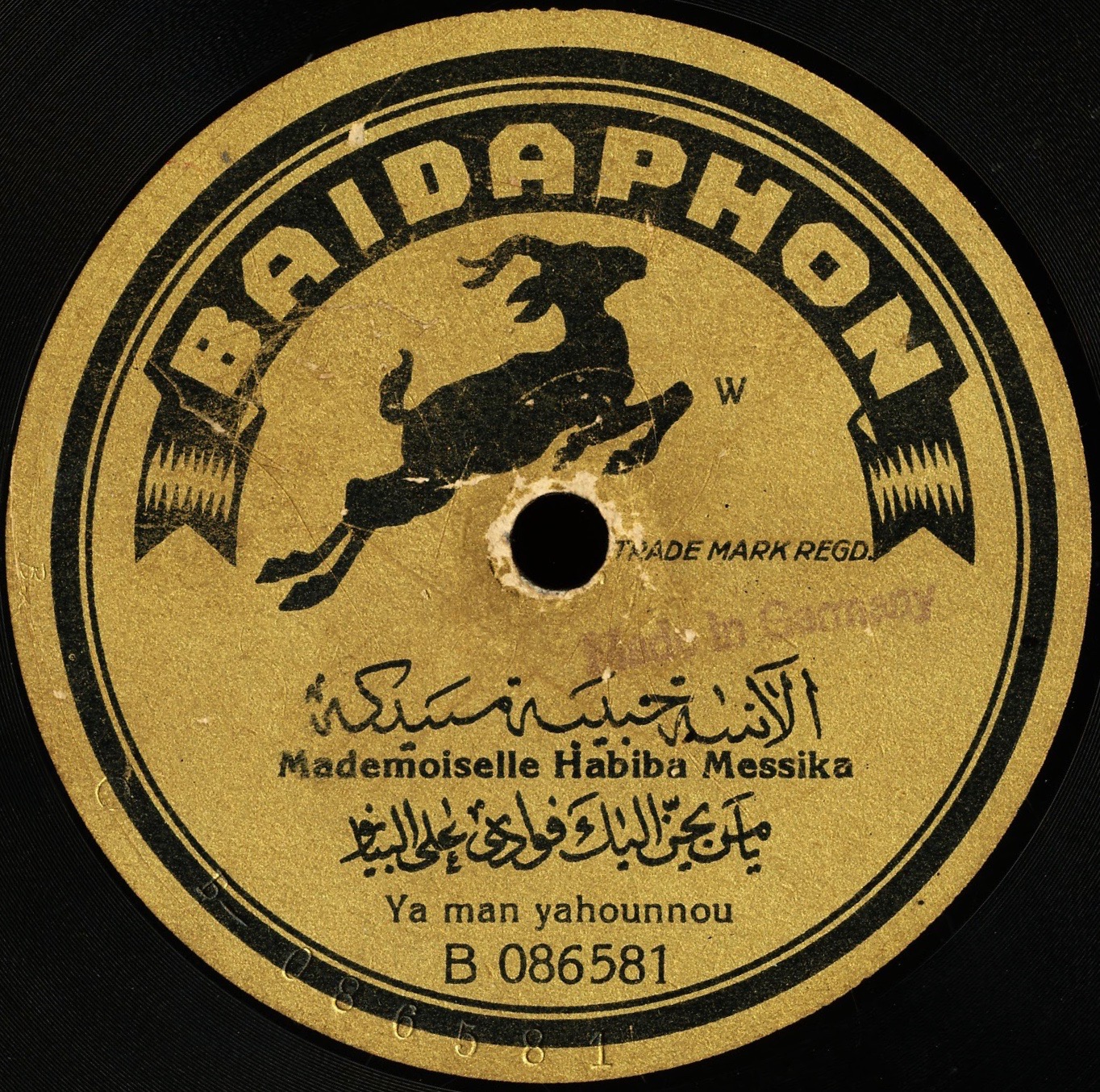
In April 1928, approximately a year after the conclusion of the Great Syrian Revolt––ninety years ago this month––Tunisian Jewish superstar Habiba Messika walked into the Berlin studio of the Baidaphon label and recorded, “Syria, you are my country” (“Souria Anti Biladi”). Alongside her was almost certainly the Tunisian Mohamed Kadri, known as “the King of Piano,” who accompanies her on the piece. For Messika (1903-1930), who had released dozens of discs for the Pathé and Gramophone labels over the previous few years, her 1928 Baidaphon sessions represented a notable departure. As I wrote about recently for History Today (The Life and Death of North Africa’s First Superstar), Berlin offered Messika a chance to record at a distance from French authorities, who were increasingly concerned by the trade in Arab discs of both local and foreign manufacture. Indeed, “Syria, you are my country,” was far from the only pan-Arabist or nationalist number she recorded with Baidaphon. The flip side of this record, for example, contains an ode to King Fuad of Egypt, entitled, “Ya man yahounnou al-Bey Fouadi.”
While Habiba Messika’s “Syria, you are my country,” was not her own creation (few of the pieces she performed were), the Tunisian Jewish artist’s interpretation was nonetheless among the most sought after records of the era.[1] And just as the popularity of Messika’s pan-Arabist disc served her well and so too garnered considerable profit for the Baidaphon label, the increasing appearance of “Syria, you are my country,” among Tunisians, Algerians, and Moroccans threw French security services into a frenzy. In the aftermath of her tragic death––she was murdered in particularly brutal fashion by Eliaou Mimouni, a deranged fan, on February 21, 1930)––Messika’s records, much to the chagrin of the French authorities, seemed to be everywhere, including in the hands of nationalists.
The perception that Messika’s Baidaphon discs were everywhere was not without merit. Messika’s records still turn up across the Middle East, in Tunisia and other parts of the Maghrib, and across the Americas. The copy in the Gharamophone archive, for example, was likely first purchased in interwar Syria before being carried in steamer truck to the United States by Syrian immigrant Saleeh Farroh. As he settled into the great Arab American hub of Detroit, Michigan, the turn-of-the-century born Farroh (or Farrah, as his name is spelled in the U.S. Census record of 1940) placed an address sticker on Messika’s record. By doing so, Farroh not only marked its provenance at the time but allowed for the tracking of its movement until the present. Sadly, decades after Farroh last played the record, Habiba Messika’s song for Syria still remains poignant.
Notes
Label: Baidaphon
Title: Anti Souria Biladi
Artist: Habiba Messika
Catalogue / Matrix Numbers: B 086596
Date of Pressing: c. 1928
Label: Baidaphon
Title: Ya man yahounnou
Artist: Habiba Messika
Catalogue / Matrix Numbers: B 086581
Date of Pressing: c. 1928
[1] Egyptian artist Mohamed Abdel Aziz also recorded “Syria, you are my country,” for the Baidaphon label. On the flip side of that record, he performed the Lebanese national anthem.
 gharamophone.com
Leave a reply to Mounir Hentati Cancel reply